The post Recap of EMUC21: The take-home messages appeared first on EMUC25.
]]>Pathology
Prof. Colecchia’s first take-home message came from the EMUC Symposium on Genitourinary Pathology and Molecular Diagnostics (ESUP) on the very first day of EMUC21, specifically from Dr. Gladell Paner’s (US) presentation. In this presentation, Dr. Paner gave updates on the new WHO classification of renal tumours. “The new WHO renal tumour classification has included morphologically-defined and molecularly-defined entities,” Prof. Colecchia said.
Later, Prof. Colecchia referred to Prof. Paolo Gontero’s (IT) presentation in Plenary Session 3 for his pathologic takeaways regarding non-muscle-invasive bladder cancer (NMIBC): “Promising urinary markers for surveillance challenge urine cytology and will likely replace it in clinical practice. No prognostic marker can currently be recommended in clinical practice. Molecular classifications are promising but are not yet ready for routine application.”
Having included the conclusions from Prof. Lars Dyrskjøt’s (DK) presentation on the use of circulating tumour DNA (ctDNA) biomarkers in high-risk and metastatic bladder cancer, Prof. Colecchia ended his summary with his vision for the future: “I have great expectations for the coming years. In particular, the molecular characterisation of uro-metastatic patients and the use of liquid biopsy in the routinary management of these patients will be the gold standard. Other useful tools that will become more prevalent are artificial intelligence and digital pathology.”
Radiation oncology
Prof. Pinkawa gave the conclusions on radiation oncology. “There is a lack of data on the treatment outcome of the use of PSMA PET in prostate cancer patients. It has clinical importance, which will be further defined in studies over the next years.” He cited Dr. Stefano Fanti’s (IT) lecture, who had said in Plenary Session 1: “The 2022 EAU Guidelines on Prostate Cancer will recommend using PSMA PET or a whole-body MRI in high-risk patients to increase the sensitivity. The guidelines will emphasise the very important limit of the lack of outcome data on subsequent treatment changes.”
About radio-immunotherapy for bladder preservation, Prof. Pinkawa said, “There are studies taking place on bladder preservation with the combination of radiotherapy and immunotherapy. Specifically in the UK, bladder preservation using radiotherapy is considered as a standard method that is more frequently used than a cystectomy, especially now in these times of COVID. But currently we don’t have convincing data considering this combination. We have some data that showed increasing toxicity that is not tolerable, and we don’t have convincing results yet that really show an improved disease-specific survival.”
Urology
European Urological Scholarship Programme (EUSP) Chair Prof. Merseburger offered the key messages of lectures intended especially for urologists. These included trial updates of “Extended vs limited Pelvic Lymph node dissection in prostate cancer” which was presented by Dr. Jean Lestingi (BR). “In a subgroup analysis, intermediate- and high-risk patients in particular, benefitted from extended lymph node dissection (EPLND). EPLND remains the gold standard for lymph node staging. Its oncological role still needs to be defined,” stated Prof. Merseburger.
He reiterated one of the key points of the Trial of Imaging and Surveillance in Seminoma Testis (TRISST) presented by oncologist Dr. Stefanie Fischer (CH) during a multidisciplinary case discussion on active surveillance: MRI is non-inferior to computer tomography, avoids irradiation, and should be recommended.
Radiology
Radiologist Prof. Oyen discussed some of lectures centred on radiology such as “The new mpMRI: Biparametric MRI: fast and accurate” by radiologist Dr. Giorgio Brembilla (IT) in Plenary Session 1: The MRI Corner: Faster and cheaper. Prof. Oyen underscored the take-home message that biparametric MRI (bpMRI) lacks dynamic contrast enhanced sequence (DCE-MRI) and may lead to greater uncertainty in lesion detection and scoring.
Oncology
The last presentation of EMUC21 came from Prof. Oldenburg, who took to the stage and provided conclusions from oncology-centric presentations. He stated PSMA PET findings are predictive for decreased biochemical recurrence (BCR) and treatment-free survival. This is one key messages from the debate “Should PSMA PET impact on treatment in newly diagnosed PCa (debate yes vs no)?” wherein Prof. Tobias Maurer (DE) represented “Yes”.
All take-home messages can be found in the EMUC21 Resource Centre. EMUC21 delegates can access all presentations, full-text abstracts, and (e-)posters here.
The 14th European Multidisciplinary Congress on Urological Cancers (EMUC22) will take place from 10 to 13 November 2022 in Budapest, Hungary. We look forward to seeing you there!
The post Recap of EMUC21: The take-home messages appeared first on EMUC25.
]]>The post Another EMUC21 day, another round of best poster award winners appeared first on EMUC25.
]]>“Because of great work, two prizes went to the same person,” Prof. Axel Merseburger (DE) said in his introduction of Dr. Ekaterina Laukhtina (AT). She managed to earn two Best Poster Awards, in the categories of “Renal Cell Cancer, Testicular Cancer & Penile Cancer” and “Urothelial Cancer.”
“Adjuvant immunotherapy versus tyrosine kinase inhibitors in patients with high-risk renal cell carcinoma: A systematic review and network meta-analysis of oncologic and toxicity outcomes” was the study that won Dr. Laukhtina and her team the Best Poster Award – Renal Cell Cancer, Testicular Cancer & Penile Cancer. “The superior oncologic benefit of pembrolizumab together with its better toxicity profile support it as the new standard of care in the adjuvant setting for nephrectomy patients at high risk of renal cell carcinoma relapse,” Dr. Laukhtina said.
Preoperative plasma level of endoglin
The Best Poster Award – Urothelial Cancer that Dr. Laukhtina received was for the study “Preoperative plasma level of endoglin as a predictor for disease outcomes after radical cystectomy for non-metastatic urothelial carcinoma of the bladder,” she and her team conducted. About this research, she said, “Preoperative plasma endoglin is associated with features of biologically and clinically aggressive urinary bladder urothelial carcinoma (UCB) as well as survival outcomes. Preoperative plasma endoglin seems to hold the potential of identifying UCB patients who may benefit from an intensified therapy in addition to radical cystectomy such as an extended lymphadenectomy or/and preoperative systemic therapy.”
Unfortunately, Dr. Laukhtina was unable to attend the session in person.
Cisplatin or carboplatin
Dr. Anke Richters (NL) also received a Best Poster Award – Urothelial Cancer for her and her team’s study “Overall survival of patients receiving cisplatin or carboplatin for primary metastatic urothelial carcinoma of the bladder: A contemporary Dutch nationwide cohort study” (see photo above). About the results of the study, Dr. Richters said:
“Metastatic urothelial carcinoma (mUC) patients receiving cisplatin or carboplatin differ on prognostic factors. Balance can be achieved through an inverse probability of treatment weighting. The overall survival benefit of cisplatin after 24 months was estimated at 2 months but was not significant. The survival benefit should be weighed against toxicity levels.”
Read the award-winning abstracts and their posters in the EMUC21 Resource Centre! Here, EMUC21 delegates can access all presentations, full-text abstracts, and (e-)posters.
The post Another EMUC21 day, another round of best poster award winners appeared first on EMUC25.
]]>The post Personalised approaches to treating GU cancers appeared first on EMUC25.
]]>Prof. Lars Dyrskjøt (DK) opened the session with his presentation “Circulating tumour DNA for decision-making in high-risk and metastatic bladder cancer.” He first gave his audience a quick refresher on ctDNA. “Mutated DNA from cancer cells is shredded into circulation. This is named ctDNA, and we can use it as a very sensitive and specific biomarker for tumour burden and metastatic spread.”
“ctDNA has the potential to be used throughout the disease course in patients with cancer,” Prof. Dyrskjøt stated. “We can use it for risk assessment before treatment and cystectomy, as a profiling tool for prognostication, for early diagnosis of minimal residual disease after radical cystectomy, and to monitor treatment response during, for instance, chemo- and immunotherapy.”
Prof. Dyrskjøt mentioned the results from a prospective study he worked on to support these statements. For instance, ctDNA-negative patients were associated with good outcomes – and the other way around. “It is a highly prognostic factor to be ctDNA-positive. ctDNA is highly correlated to disease outcome,” he said, referring to the slide below.
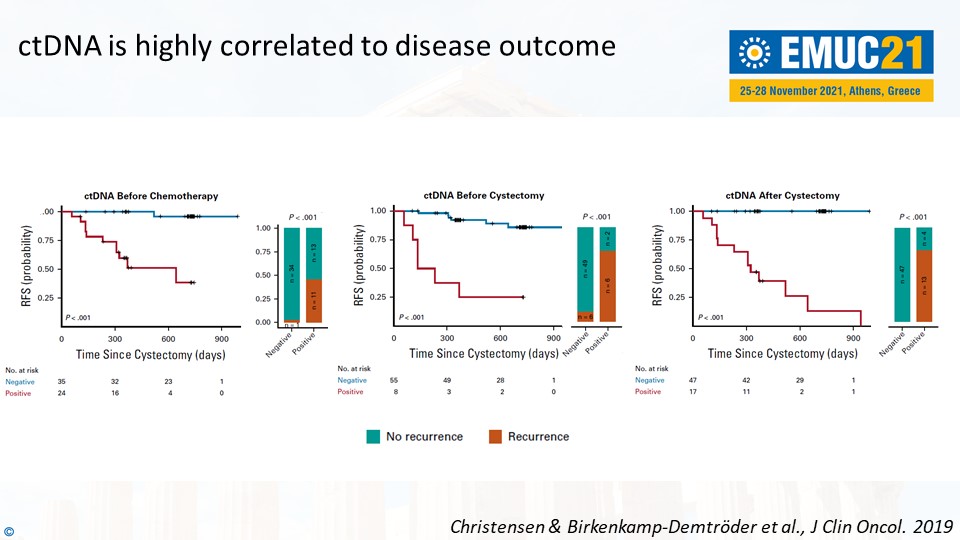
Prof. Dyrskjøt concluded, “What we need to demonstrate now is the clinical impact of ctDNA-based guidance. Can it improve the overall survival? Can it improve the quality of life? Can we reduce costs?”
Practical tips on genetic testing in prostate cancer
In the following presentation, Dr. Elena Castro (ES) gave practical tips on genetic testing in prostate cancer to the attending delegates. “We should consider assessing the HR status early, because it may take some time to retrieve blocks or to consider a re-biopsy. It’s good to know that the BRCA1/2 mutations rarely change status over time. Poly (ADP-ribose) polymerase inhibitors are currently approved after progression to androgen receptor signalling inhibitors (ARSis).”
“Finally, we should offer germline testing to all patients with metastatic prostate cancer. Somatic tests are not validated for germline assessment. We shouldn’t forget to exclude the potential germline origin of the mutations in the cancer-related genes from tumour analyses.”
The other two lectures in Plenary Session 8 were presented by Dr. Maria Rosaria Raspollini (IT) and Prof. Francesco Ceci (IT). (Re)watch all presentations of Plenary Session 8 as webcasts in the EMUC21 Resource Centre. EMUC21 delegates can access all scientific content here. All presentations, full-text abstracts, and (e-)posters are easily accessible in the Resource Centre.
The post Personalised approaches to treating GU cancers appeared first on EMUC25.
]]>The post EMUC21 shines spotlight on best poster winners appeared first on EMUC25.
]]>Oncologist Dr. Simon Spohn (DE, see photo above) received the award for his team’s study “PSMA PET- and mpMRI-guided focal radiation dose escalation in primary prostate cancer patients – a planned safety analysis of a two-armed prospective phase-2 trial (HypoFocal).”
“Combined PSMA PET and mpMRI-based ITM definition results in significantly larger boost volumes. Despite these large boost volumes, the focal dose escalation was feasible for both arms, showing acceptable acute GU and GI toxicities without compromising QoL,” the conclusion of the study read. “Radiation proctitis demands careful management.”
Dr. Spohn added, “We will further evaluate this approach in a phase-3 trial, in which we will compare moderately hypofractionated radiotherapy with focal-dose escalated SBRT and intervening PSMA PET.”
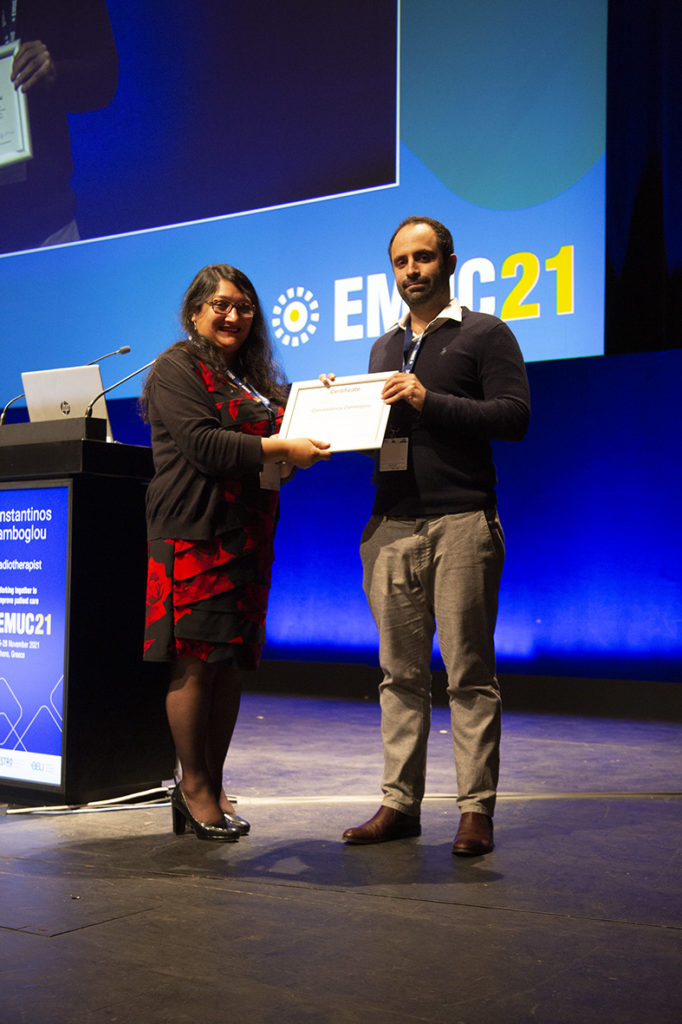
Dr. Constantinos Zamboglou (DE, right) receives the award for Best Poster – Prostate Cancer
MFS after sRT in the PSMA PET era
Radiotherapist Dr. Constantinos Zamboglou (DE), who was also part of Dr. Spohn’s team, was bestowed the award for the “Metastasis-free survival after salvage radiotherapy for post-operative prostate cancer patients in the PSMA PET/CT era – a multicentre analysis” study (see Photo 2). In this multicentre study, PSMA PET/CT was used to guide salvage radiotherapy (sRT) in all patients.
“The strong prognostic impact of PSA serum values prior to sRT on metastasis-free survival (MFS) is confirmed,” Dr. Zamboglou said. “Additionally, the presence of PET-detected pelvic lymph nodes is proposed as a new biomarker associated with MFS after sRT in the PSMA PET era.”
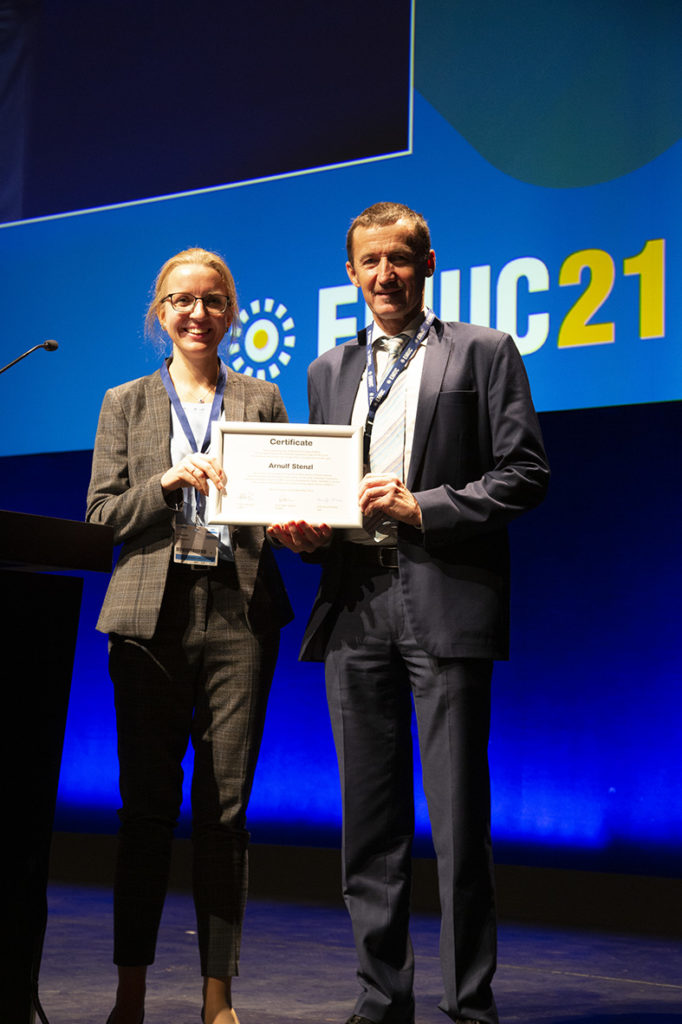
Prof. Arnulf Stenzl (DE, right) accepts the award for Best Poster – Prostate Cancer
mCRPC-patient pain burden
Finally, Prof. Arnulf Stenzl (DE) accepted the award for the “Patient-reported pain by baseline pain status in men with metastatic Castration-Resistant Prostate Cancer (mCRPC) receiving Talazoparib (TALA): TALAPRO-1” study (see Photo 3).
“Don’t look at me, but look at the authors. There are many of those that have probably contributed more than I did. This is definitely a study we are proud of,” Prof. Stenzl said before receiving the award.
About the study, he said, “Among patients with moderate or severe pain at baseline, treatment with talazoparib was associated with an improved pain burden, except for the pain interference in the non-BRCA1/2 subset. No changes in the pain burden were observed among patients with asymptomatic or mild pain at baseline.”
Read the award-winning posters in the EMUC21 Resource Centre! EMUC21 delegates can access all scientific content here. All presentations, full-text abstracts, and (e-)posters are easily accessible here throughout the congress.
The post EMUC21 shines spotlight on best poster winners appeared first on EMUC25.
]]>The post Bladder-preserving strategies unveiled: Topical therapy and TURBT appeared first on EMUC25.
]]>After Prof. Paolo Gontero (IT) and Dr. Gianluca Giannarini (IT) had given their respective presentations on the use of biomarkers and innovative approaches, Prof. Alfred Witjes (NL) lent his expertise to answer the question of how topical therapy could be improved for bladder preservation in patients with NMIBC.
“Apply proper standard instillation principles, like dehydration and the use of correct doses and frequencies,” Prof. Witjes said. “Electro-Motive Drug Administration (EMDA) and conductive chemo-hyperthermia will certainly improve the efficacy to some extent. Radiofrequency-induced chemo-hyperthermia works and is supported by most data.”
He went on to give his vision of the future: “The Gemcitabine-Releasing Intravesical System looks interesting, but several studies into this are still ongoing. As for thermosensitive gel and liposomes, we are not there yet for NMIBC – but keep your eyes open. With regard to combination therapy, docetaxel for Bacillus Calmette-Guerin-naïve NMIBC looks promising. New forms of immunotherapy combined with intravesical therapy are under investigation.”
How to perform a high-quality TURBT
Prof. Athanasios Papatsoris (GR) gave a lecture on how to perform a transurethral resection of a bladder tumour (TURBT) of a quality as high as possible, referencing numerous studies throughout his presentation. One of them offered a “TURBT checklist,” which Prof. Papatsoris showed with his two slides below.
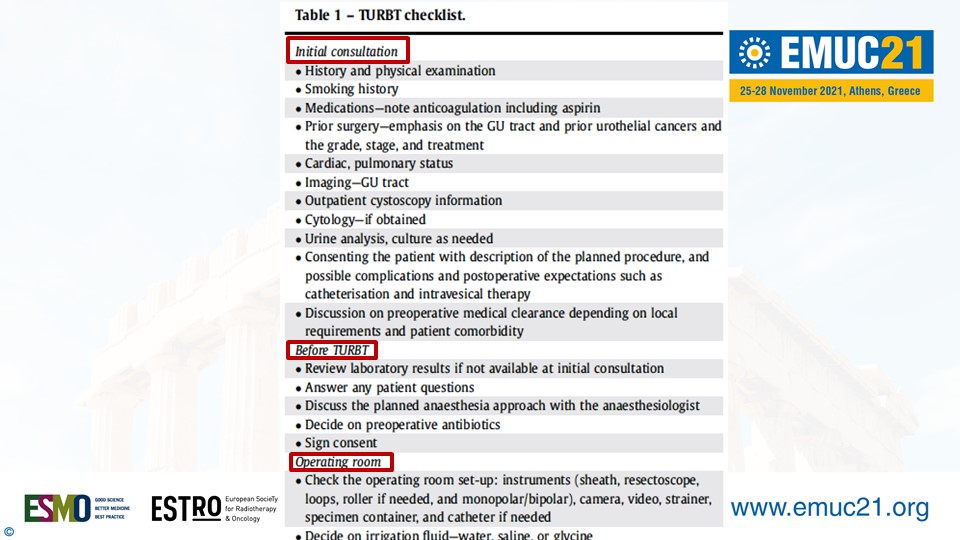
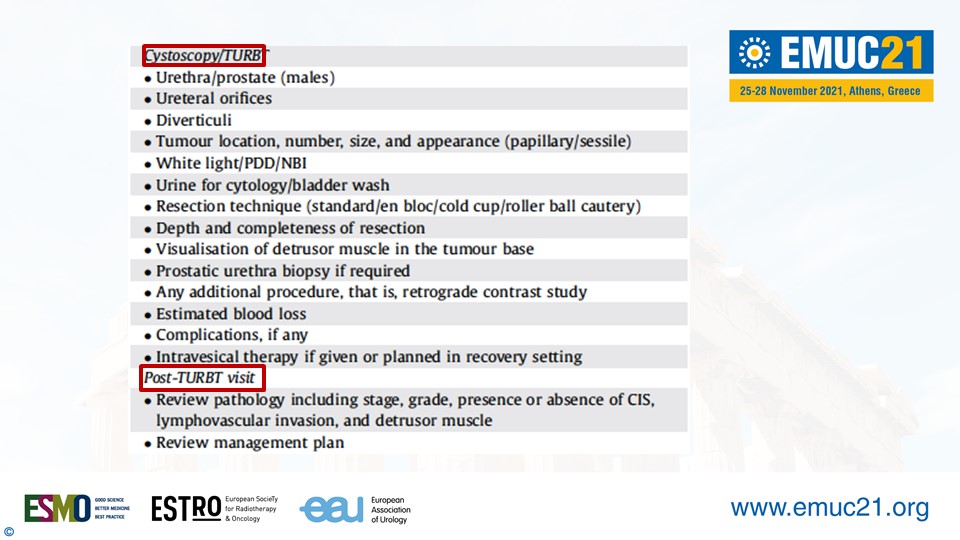
“Attention to detail and a permissive set-up are crucial to an effective TURBT,” Prof. Papatsoris explained. “We need to standardise the technique and learning curve for en-bloc TURBT. En-bloc TURBT has many potential pros, such as tumour sampling in a single piece, shortening of the procedure time and hospitalisation, and the relative reduction of complications and the need for re-TURBT. However, pathologists are not familiar with en-bloc TURBT yet and there is no consensus on the resection tool and energy source yet.”
Prof. Papatsoris ended his presentation putting the spotlight on a procedure that could combine the best of two tools, namely external beam radiotherapy (ERBT) and en-bloc TURBT. “In theory, optical molecular imaging-assisted en-bloc tumour resection integrates the advantages of both and is expected to improve the quality and completeness of transurethral tumour resection, and ultimately improve the oncological outcomes of patients with NMIBC,” Prof. Papatsoris quoted from a study in Frontiers in Oncology. “There are studies underway assessing the combination of en-bloc TURBT and molecular imaging.”
(Re)watch Prof. Papatsoris’ and Prof. Witjes’ full presentations in the EMUC21 Resource Centre. EMUC21 delegates can access all scientific content here. All presentations, full-text abstracts, and (e-)posters will become easily accessible here throughout the congress.
The post Bladder-preserving strategies unveiled: Topical therapy and TURBT appeared first on EMUC25.
]]>The post PSMA PET/CT: Prime tool in staging and treatment monitoring appeared first on EMUC25.
]]>In his pre-recorded lecture “Optimal staging approach in men recurring after primary treatment”, Prof. Declan Murphy (AU) stated, “There is no role for imaging in patients with PSA > 0.2 ng/mL detectable on an ultrasensitive assay.”
He cited three publications (1) which confirmed that the cancer benefit of waiting for PSA to reach 0.2 ng/mL first and then offering salvage radiotherapy is as good as providing adjuvant radiotherapy when the PSA is below 0.2 ng/mL. Moreover, it is less toxic and overtreatment can be avoided. He added that imaging may have a role within the range of 0.2 ng/mL up to about 2 ng/mL.
According to Prof. Murphy, conventional imaging such as CT and bone scan is pointless in these low-range settings. “Please don’t do a CT and bone scan when the PSA climbs above 0.2 ng/mL even just to reassure your anxious patients. MRI has a role for staging loco-regional recurrence especially if novel imaging is unavailable.”
He underscored that PSMA PET/CT is the best imaging tool for biochemical recurrence as it is the most sensitive and the most specific imaging modality for biochemical recurrence for PCA patients. “Use PSMA PET/CT once the PSA is above 0.2 ng/mL as it may change your management.”
Prof. Murphy referred back to the findings of the aforementioned three publications (1) which collectively substantiated that PSMA PET/CT has an impressive sensitivity for detecting disease in men with biochemical recurrence even at very low PSA levels of < 1 ng/mL with specificity well above 90%. He added, “PSMA PET/CT offers a safe, one-stop whole-body scan with excellent tumour-to-background-contrast ratio.”
Treatment monitoring
Following Prof. Murphy’s presentation was the lecture of radiologist Dr. Ekaterini Tavermaraki (GR) entitled “How to use imaging for treatment monitoring in metastatic prostate cancer”.
Dr. Tavermaraki stated that conventional imaging still has a role in the follow-up of patients under systemic treatment. She added that modern PSMA PET/CT imaging techniques provide better sensitivity and specificity for metastases detection, especially in biochemical recurrence in low values of PSA. Subcentimeter-target lesions which are not measurable at CT, are visualized. PSMA PET/CT imaging provides earlier response information than anatomic imaging methods.
She also mentioned the pitfalls of PSMA PET/CT which include low to moderate PSMA expression in osteoblastic activity, moderate uptake in haemangiomas, and chronic inflammation can also be associated with PSMA uptake. She stated, “All of these cases correlate with anatomic findings. If there is uncertainty, ongoing monitoring of the PSA level with follow-up PSMA PET is suggested.”
In addition, the limitation of PSMA PET/CT is that if the primary tumour is not PSMA-avid, the sensitivity for detecting nodal or distant metastatic disease will be lower, and closer attention must be given to anatomic review.
Watch the full presentations of Prof. Murphy and Dr. Tavermaraki and other must-view presentations of Plenary Session 1 via the Resource Centre.
References:
- Gallium-68 Prostate-specific Membrane Antigen Positron Emission Tomography in Advanced Prostate Cancer-Updated Diagnostic Utility, Sensitivity, Specificity, and Distribution of Prostate-specific Membrane Antigen-avid Lesions: A Systematic Review and Meta-analysis (Perrera et al, Eur Urol 2020)
- Assessment of 68Ga-PSMA-11 PET Accuracy in Localizing Recurrent Prostate Cancer: A Prospective Single-Arm Clinical Trial (Fendler, Calais, Eiber, et al., JAMA Oncol 2019)
- Diagnostic Performance of 18F-DCFPyL-PET/CT in Men with Biochemically Recurrent Prostate Cancer: Results from the CONDOR Phase III, Multicenter Study (Morris et al., Clin Can Res 2021)
The post PSMA PET/CT: Prime tool in staging and treatment monitoring appeared first on EMUC25.
]]>The post Strengths and limitations of PSMA PET: When to use it (and when not to) appeared first on EMUC25.
]]>Nuclear medicine physician Dr. Fanti kicked off the session with his state-of-the-art lecture “Strengths and limitations of PSMA PET for primary staging.” “To every extent, PSMA PET has been a gamechanger,” Dr. Fanti said. “Today, PSMA PET is widely used in many situations all around the world.”
“As for the use of PSMA PET in PCa staging, some papers really made a difference. One of those was an Australian prospective, randomised, multicentre study, which clearly demonstrated that PSMA PET was superior to conventional imaging in patients with high-risk PCa.”
“The 2022 EAU Guidelines on Prostate Cancer will recommend using PSMA PET or a whole-body MRI in high-risk patients to increase the sensitivity,” Dr. Fanti continued. “The guidelines will emphasise the very important limit of the lack of outcome data on subsequent treatment changes. PSMA PET is more accurate than CT and a bone scan, but we don’t know if there will be an impact on overall survival. And we know that a better accuracy does not necessarily mean better outcomes. Having said that, there’s a strong rationale behind using PSMA PET in patients with high-risk disease.”
Dr. Fanti concluded, “PSMA PET is a robust imaging methodology, non-invasive and patient-friendly, with a clear procedure and a wide availability worldwide. It will have a further role in staging high-risk patients.”
Debate
In the following debate, Prof. Maurer and Dr. Walz answered the question of whether PSMA PET should have an impact on the treatment of newly diagnosed PCa: yes (Prof. Maurer) or no (Dr. Walz).
Prof. Maurer asked his audience, “Do we know whether PSMA PET leads to better outcomes? Most of you will say, ‘We don’t know that,’ and for the most part that’s true. But I will show you a specific scenario in which I believe PSMA PET already makes a difference today.” He went on presenting the slide below.
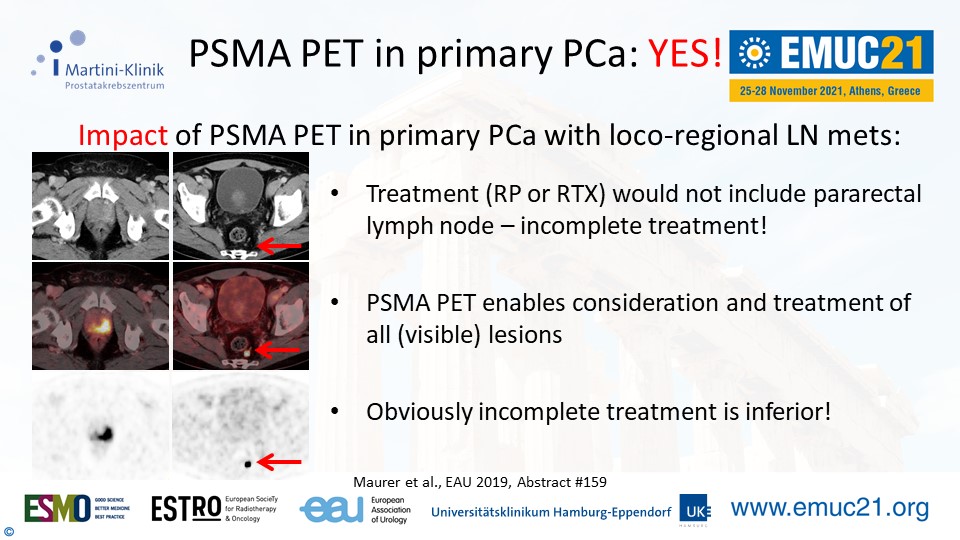
“My recommendation is to consider PSMA PET in the cases of unfavourable intermediate and high-risk PCa. Certainly there are still a lot of unanswered questions. But we, and our patients, now have an imaging tool that helps us better understand the disease state. So PSMA PET for primary PCa? Yes, please!”
Dr. Walz’ presentation followed right after. He said, “The difference between PSMA and conventional imaging is that the former’s increased sensitivity detects especially lymph node metastases. But what is the consequence of this increased sensitivity?”
“Should we abandon local treatment in ciM0/miM1? Provide systemic treatment only? Disregard the information gained from PSMA? Choose local, systemic, and metastases-directed treatment? So far we don’t know.”
He concluded his presentation with a quote from Prof. Henk Van Der Poel (NL), who was attending the presentation. “Care should be taken to avoid unproven treatment decisions that may result in undertreatment [or overtreatment] and finally harm to patients.”
Get the full perspective from both sides by (re)watching the presentations. EMUC21 delegates can access all scientific content in the EMUC21 Resource Centre. All presentations, full-text abstracts, and (e-)posters will become easily accessible here during the congress.
The post Strengths and limitations of PSMA PET: When to use it (and when not to) appeared first on EMUC25.
]]>The post Definitive: EMUC21 is coming to Athens! appeared first on EMUC25.
]]>Relive and enjoy the congress experience, meet and connect with peers and key opinion leaders face-to-face, and join the knowledge-exchange first-hand at the much-awaited 13th European Multidisciplinary Congress on Urological Cancers (EMUC21). The congress will welcome delegates from around the world from 25 to 28 November 2021 in picturesque and historic Athens.
Through the collaboration of the EAU, the European Society for Medical Oncology (ESMO), and the European SocieTy for Radiotherapy and Oncology (ESTRO), the four-day congress will constitute of new crucial updates in the prevention, diagnosis and management of genito-urinary (GU) cancers.
In this article, highly-regarded experts and EMUC21 Steering Committee members, Prof. Aristotelis Bamias (GR), Prof. Peter Hoskin (GB), and Prof. Arnulf Stenzl (AT) shared what participants can expect at the upcoming congress; from current challenges to anticipated breakthroughs in the field.
New scientific updates in the programme
“EMUC21 will cover a plethora of developments with regard to GU cancers, and emphasise the importance of a multidisciplinary approach when providing the best care to our patients. Interactivity will be encouraged,” stated Prof. Bamias. He added, “Some of the major updates at the congress will include the new WHO classification on GU cancers, modern imaging in prostate cancer, integrating systemic therapy in non-muscle-invasive bladder cancer (NMIBC), and molecular developments in the field.”
Prof. Stenzl further elaborated on what new developments the congress will offer:
- On prostate cancer
The diagnostic and therapeutic possibilities of PSMA-PET-CT based on the most recent data will be thoroughly discussed, particularly stage imaging and therapy (e.g. PSMA-Radio-Ligand- Therapy) with PSMA. - On bladder and urothelial cancers
New developments such as urinary tract topical therapy with a new agent, possible physical enhancement, and more will be presented. - On advanced urothelial cancer
The status of checkpoint-inhibition and emerging data from recent studies will be examined and deliberated. Furthermore, circulating tumour DNA is a new and promising tool. Researchers from Denmark are at the forefront of this technology and will present exciting perspectives. - On renal cell cancer
The role of local or regional therapy, in addition to systemic therapy, will be discussed by a multidisciplinary panel. Moreover, an update on new trials such as FLAME (Focal Lesion Ablative Microboost in prostatE cancer), IMvigor130, CLEAR, and the extent of lymph node dissection in prostate cancer, to name a few will be part of the congress.
Prof. Hoskin stated, “A few lectures will focus on the combination of immunotherapy with local treatment in several GU cancers. Then these lectures will be followed by presentations on personalised approaches in GU cancers wherein experts from various disciplines will offer their insights.”
Major challenges in interdisciplinary approach
“I think we have entered an era characterised by our belief that metastatic GU cancer can be associated with long-term survival without disease progression, and that cure is possible. This is thanks to the close collaboration and involvement of all disciplines, which are represented in EMUC congresses. The major challenge is the optimal utilisation of our diagnostic tools (including molecular markers) in order to personalise our approach and achieve maximum benefit for our patients,” stated Prof. Bamias.
According to Prof. Stenzl, some of the major challenges in the interdisciplinary approach of patient care include communication, knowledge and understanding. He explained, “Advances in one field may not be communicated well to other disciplines involved in patient treatment. Sometimes, the implications of these advancements may not also be well understood by other disciplines, and can lead to misunderstanding. In practice as an example, we still do not know the role of salvage lymphadenectomy in prostate cancer, treatment of oligometastatic urothelial cancer, the extent of salvage tumour resection/nephrectomy in advanced and/or metastatic renal cell cancer. What is important is the understanding of all disciplines in the sequence of the respective possibilities of treatment.”
In the coming decade
“In my opinion, further developments in immunotherapy and technology such as diagnosis, circulating tumour DNA for both diagnosing residual disease after priority treatment, and monitoring of systemic therapy. are on the horizon. These will be a great help for all doctors and patients in the field of uro-oncology,” concluded Prof. Stenzl.
How to join EMUC21
Register now to participate in the upcoming congress here. Delegates are entitled to access to the scientific sessions, industry sessions and the exhibition. For the complete Scientific Programme, please click here.
About ESUI21

The 9th Meeting of the EAU Section of Urological Imaging (ESUI21) will take place on 25 November 2021 in conjunction with EMUC21. Expect extensive assessments of technological applications in image-guided approaches.

ESUI21 will also investigate how imaging enhances urological diagnostics and intraoperative visualisation, and helps define the standardisation of the reporting of urological cancers. For more information, please visit www.esui.org.
The post Definitive: EMUC21 is coming to Athens! appeared first on EMUC25.
]]>The post Radioligand therapy: multidisciplinary collaboration for health system readiness appeared first on EMUC25.
]]>Join the EMUC21 session ‘Radioligand therapy: multidisciplinary collaboration for health system readiness’ on 25 November, from 16:30 to 18:00.
The session, hosted by The Health Policy Partnership (HPP), will discuss radioligand therapy – an innovative and targeted approach in oncology – and its potential role in prostate cancer care. This event is especially significant, given the recent release of data from the VISION trial on the use of radioligand therapy for advanced prostate cancer.
Radioligand therapy’s integration
With potential regulatory approval for radioligand therapy in prostate cancer on the horizon, we must carefully plan how the approach is integrated into existing care pathways. The need to proactively prepare for radioligand therapy’s integration from a multidisciplinary and systems perspective will be highlighted during this session. We hope to catalyse discussions on what a ready policy environment for radioligand therapy looks like at both the EU and national levels.
The session will see Professor Hein Van Poppel (European Association of Urology) discuss why a multidisciplinary approach to prostate cancer care is important. Dr John Buscombe (British Nuclear Medicine Society) will speak on what radioligand therapy is and its potential use in prostate cancer. Erik Briers (Europa Uomo) will also analyse the potential impact of radioligand therapy from a patient perspective.
Radioligand Therapy Readiness Assessment Framework
Christine Merkel (HPP) will then discuss how the recently launched Radioligand Therapy Readiness Assessment Framework can be used to support proactive and data-driven policy development for radioligand therapy, with key findings and policy priorities around prostate cancer in the UK and US being presented. Ms Merkel will go on to moderate a panel discussion with Dr Andreas Charalambous (European Oncology Nursing Society), Dr Jolanta Kunikowska (European Association of Nuclear Medicine), Dr Boris Hadaschik (Essen University Hospital), Professor Silke Gillessen (Oncology Institute of Southern Switzerland) and Professor Gert De Meerleer (UZ Leuven) to discuss how the clinical community can create a ready and multidisciplinary system for radioligand therapy. The panel will also take questions from the audience.
Explore all that the EMUC21 scientific programme has to offer you here. Residents, medical students, nurses, full-time researchers, and patient advocates can benefit from discounted fees. Register today and save here!
Please visit www.radioligandtherapy.com for further information on the Radioligand Therapy Readiness Assessment Framework.
The post Radioligand therapy: multidisciplinary collaboration for health system readiness appeared first on EMUC25.
]]>