The post United voices for prime GU cancer care: Specialists to convene at EMUC25 appeared first on EMUC25.
]]>Curious about the scientific content at the upcoming 17th edition of EMUC (EMUC25)? The Steering Committee Members offer you a preview of some of the congress highlights in this article.
Not only for urologists
The EMUC scientific programme is also consistently relevant, timely, and beneficial to a broad range of specialists.
“Although urologists traditionally attend EMUC, the faculty and participants comprise medical oncologists, radiation oncologists, nuclear medicine radiologists, pathologists, and other experts who are involved in the care of GU cancer patients. This results in fruitful discussions and, of course, well-rounded solutions,” said Dr. Elena Castro (ES), a Steering Committee Member representing the European Society for Medical Oncology (ESMO).
She added, “Multidisciplinarity is what scientific societies believe should guide the care of patients with GU tumours.”
Content for every GU cancer care specialist
Prof. Arnulf Stenzl (DE), Secretary General of the European Association of Urology (EAU), highlighted the sessions that cover the role of artificial intelligence in supporting patients’ journeys. He said, “The discussions about imaging helping to avoid biopsy in urological cancers will be interesting for clinicians. The session on hereditary GU cancers will also be a key highlight for those who seek answers in this complex thematics.”
Dr. Alison Tree (GB) of the European SocieTy for Radiotherapy and Oncology (ESTRO) also shared more topics to look forward to at EMUC25.
“A topic that will be interesting to explore is how to make the future of GU oncology care sustainable while treating patients more effectively and efficiently. Participants can also enjoy learning from multi-disciplinary viewpoints during the case discussions on rare and unconventional pathologies, to learn more about the “Cinderella tumours”.
“In addition, the Game-Changing Session on the CREST, AMPLITUDE metastatic HSPCa, and PACE trials is a must-attend,” stated Dr. Tree.
Explore the EMUC25 scientific programme now to know more.
Have your say
Prof. Stenzl emphasised “EMUC25’s scientific content is always an amalgamation of the latest literature and developments in the field of uro-oncology, discussed with the delegates by the various players in the field of uro-oncology. “
Dr. Castro added, “Key opinion leaders, seasoned experts, and younger colleagues may have different perspectives and at EMUC, we listen to these voices. EMUC is also an excellent stage to present research in an international and interdisciplinary setting.
“Furthermore, several sessions and courses that take place in smaller groups are designed to offer participants opportunities to have their say. There is ample time for discussions, interaction, and networking, such as during the Poster Session, which is one of my favourite sessions,” concluded Dr. Castro.
Discover more about EMUC25 here. Interested in presenting at the congress? Check out the information on abstract submission.
If you would like to attend EMUC25 as a delegate, register now to take advantage of special rates.
The post United voices for prime GU cancer care: Specialists to convene at EMUC25 appeared first on EMUC25.
]]>The post Synergy of specialties at EMUC23: Why MDTs are paramount to optimal patient care appeared first on EMUC25.
]]>As always, the scientific programme of the upcoming 15th edition (EMUC23) will reflect the interdisciplinary approach in the treatment of genitourinary (GU) cancers but will have new features. This article offers information on the latter, the value of a multidisciplinary team (MDT), and viewpoints from some of the distinguished members of the EMUC Steering and Scientific Committees.
New and improved programme
To further solidify the multidisciplinary nature of the congress, the meeting of EAU Section of Urological Imaging (ESUI) will merge with the congress. Crucial updates such as the latest evidence in imaging trials and their clinical implications; unmet needs in uro-oncology imaging; other imaging modalities, and more will kickstart EMUC23 on 2 November 2023.
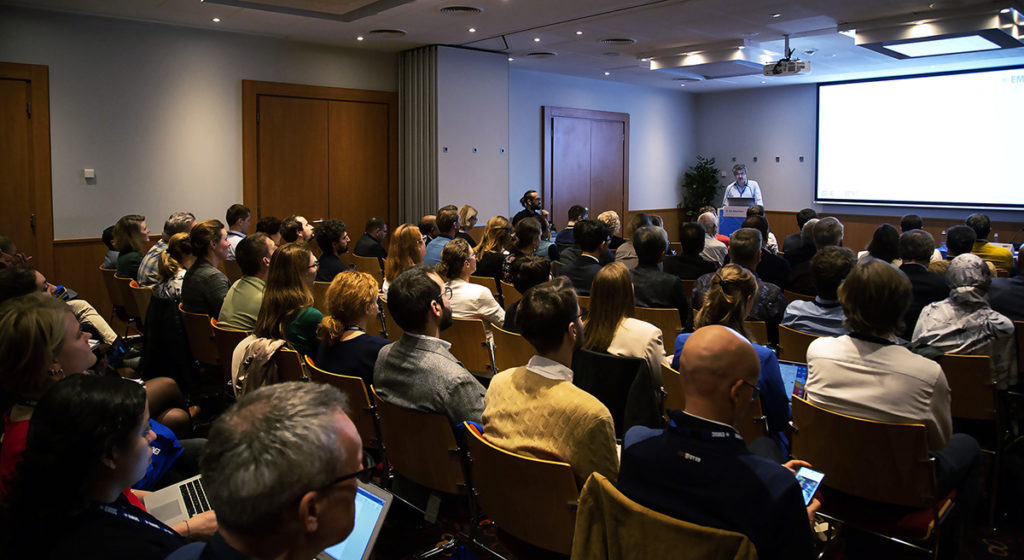
The ESUI meeting will merge with this year’s EMUC23 programme.
In addition, one of the most popular features of the scientific programme, the Multidisciplinary Case Discussions, will be more data-driven, infused with robust statistics, and delivered in an improved structured format.
To enrich the EMUC23 experience, the exhibition will also be a must-visit element of the congress showcasing innovations in equipment, scientific publishing, and pharmaceuticals.
EMUC23 and nuclear medicine
Prof. Daniela Oprea-Lager (NL) stated that attending EMUC23 will not only be beneficial to her fellow nuclear medicine physicians, but to other healthcare professionals as well. “The congress will deliver novel developments from the preclinical to the clinical levels of interest. EMUC23 will be a platform where various perspectives are offered and topics on imaging are adequately integrated during the patient case discussions. Experts from diverse fields will brainstorm and deliberate to improve clinical practice and to avoid futile treatments in categories of patients who might not respond to therapy.”
Prof. Oprea-Lager shared that her favourite EMUC sessions are the Multidisciplinary Case Discussions and Game Changing sessions, where interdisciplinary collaboration will be at its pinnacle. She said, “Generally, there are various possibilities when treating certain patients. The key is selecting the most appropriate approach, capitalising the benefit, and minimising the adverse effects and costs.”
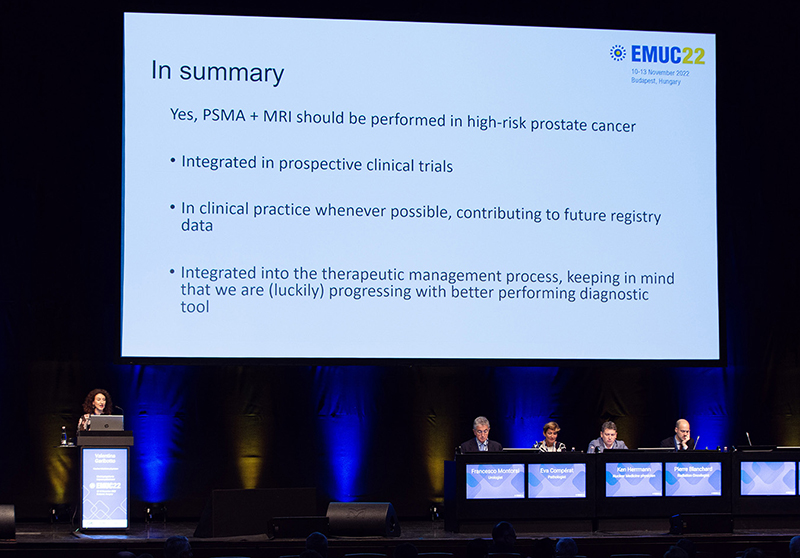
During EMUC22, nuclear medicine physician Prof. V. Garibotto (CH) deliberates why PSMA + MRI should guide treatment algorithm in high-risk prostate cancer.
Role in the MDT
“With the implementation of next-generation imaging and the theragnostic concept in clinical practice, the tasks of the imaging doctor became complex. We see what we treat and we treat what we see, but the aims are to position the patient centrally and to act from an individualised perspective,” she said. According to Prof. Oprea-Lager, this is how to carry out these aims:
-
-
-
- Speak the same language with clinical partners
“Imaging doctors, nuclear medicine physicians, and radiologists, need to have the knowledge and high level of expertise to function as equal discussion partners.” - Identify the gaps in daily practice
“Push the limitations and innovate towards answering clinical needs by using imaging tools.” - Be aware of the consequences of “seeing more and treating more”
“Nowadays when we see more, we may upstage/downstage disease and change the initially proposed treatment plan for a still unknown survival benefit. However, the nuclear medicine physician has to possess a good understanding of all factors related to disease history, current medical status, metastatic patterns of urological cancers, pitfalls, and final image interpretation. Once we have these, we can adequately stage/re-stage patients and plan the optimal treatment in dialogue with the clinicians in the MDT and with the patient.” - Adequately select and identify the ideal candidates (i.e. patient categories that may benefit from the proposed treatment)
“Patient selection and response evaluation criteria based on harmonised, repeatable protocols, and adequately performed scans are some of the most challenging tasks of the new-generation imaging doctors.”
- Speak the same language with clinical partners
-
-
Solving dilemmas together
According to Prof. Oprea-Lager, MDT has been implemented in the Netherlands for more than 10 years. However, the presence of radiologists and nuclear medicine physicians in the MDT is a novel element. She explained, “It all began with the need to have all key specialties present in the multidisciplinary process of diagnosis and treatment of patients with urological cancers. Nowadays, specialist diversity is a matter of shared decisions and best-practices approach within the large uro-oncology domain. We are not competing with other disciplines; we try to solve dilemmas together, and successfully translate anatomic and metabolic knowledge into the clinical pathways.”
EMUC23 and medical oncology
“We, medical oncologists, generally focus on advanced disease. Most scientific meetings have sessions that only cover this topic and topics related to it. In contrast, EMUC provides updates and knowledge exchange on various stages of GU cancers. It is during the early stages that plenty of evidence is generated. This can change or will change clinical practice. With this in mind, it is in the best interest of our patients to keep ourselves updated and EMUC can help with that,” said Dr. Elena Castro (ES).
Advantages of MDT
According to Dr. Castro, when the management of GU tumours becomes increasingly complex due to multiple treatment options, a well-coordinated MDT is paramount in pinpointing the most appropriate disease management. She explained, “This is especially true in patient cases with particularities that have more than one potential option and/or when the Guidelines do not currently offer clear recommendations. I personally find MDT discussions very helpful in coming up with the best care possible as the decision is not based on one person’s point of view. Additionally, MDTs are essential in identifying candidates suited for clinical trials as they could benefit from treatments not yet widely available.”
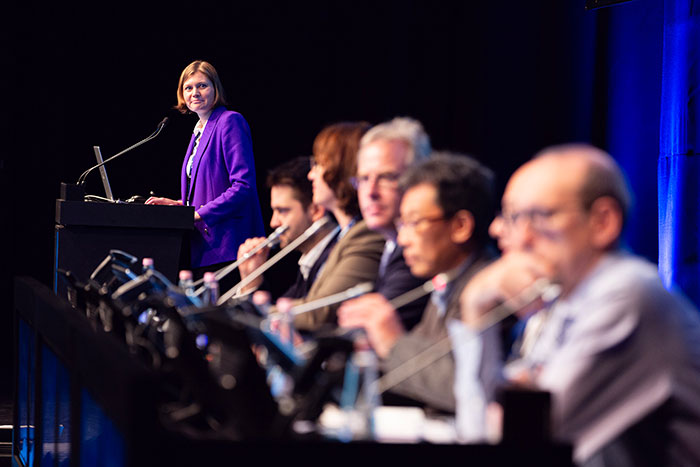
Urologist Dr. T. Kuusk (GB) presents a case on adjuvant treatments and recurrent disease during the Multidisciplinary Case Discussion session on kidney cancer at last year’s EMUC.
Dr. Castro shared that in her practice, most GU patients with localised disease who benefit from localised treatment or even surveillance, are usually managed by urologists or radiation oncologists. However, there are some cases that may require neoadjuvant or adjuvant systemic treatment. Thus, coordination between surgeons and medical oncologists is key.
Patients with (recurrent) metastatic disease are usually referred to the medical oncologist. Concerning prostate cancer, some patients with metastatic disease are managed by urologists or radiation oncologists. These patients are then referred to the medical oncologists after progression to the initial therapy or if the most appropriate treatment requires chemotherapy or other systemic treatments.
Spain’s take on MDT
“If not in all, in most tertiary hospitals in Spain, MDTs are the common way to manage cancer patients for GU tumours and most tumours. The composition of the MDTs may vary depending on the specialists that are relevant for a particular tumour type, but MDTs typically include surgeons, medical oncologists, radiation oncologists, pathologists, and radiologists. For instance, for prostate cancer, it is important that the nuclear medicine specialists are also involved,” stated Dr. Castro.
MDT becoming compulsory?
According to EAU Secretary General and EMUC Steering Committee member, Prof. Arnulf Stenzl (AT), an MDT’s involvement in treating onco-urology patients may become imperative in health insurance matters. He stated, “We see insurance companies and authorities in several countries require that onco-urology patients must be seen by a multidisciplinary tumour board to receive reimbursements for a systemic (or new interventional) treatment or diagnosis such as PSMA-related diagnosis or treatment. It would be beneficial if medical specialists become more informed in many aspects of GU cancer treatment beyond the scope of their core specialism.”
| Join us at EMUC23 |
| EMUC23 is an all-encompassing congress designed to enrich your clinical practice and patient care. Explore the congress’ scientific programme to know what’s in store for you. Secure your place at EMUC23 and register now to benefit from the early-fee rates. Don’t miss out! |
The post Synergy of specialties at EMUC23: Why MDTs are paramount to optimal patient care appeared first on EMUC25.
]]>The post EMUC22: Relevant topics and Prof. Stenzl’s personal highlights appeared first on EMUC25.
]]>In this article Prof. Arnulf Stenzl (DE), who is one of EMUC22’s esteemed Steering Committee members and the EAU Adjunct Secretary General – Executive Member Science, offers a preview of the most relevant topics at the congress, as well as, his personal EMUC22 highlights.
What are the most relevant topics at EMUC22 and why?
Prof. Stenzl: As a large part of our practice is early detection of prostate cancer, Plenary Session 1: New tools for meaningful questions in early-stage prostate cancer will provide crucial insights into clinically meaningful methods. The session will deliver varying perspectives on whether MRI-targeted and systematic biopsies are still the roadmap for therapy. The delegates will learn how the teamwork among radiologist, a urologist, radiation oncologist and a focal therapist can be the best way in treating patients. In addition, there will be a deliberation on whether or not PSMA (prostate-specific membrane antigen) with MRI is the treatment guide algorithm in high-risk prostate cancer.
The same goes for early detection and monitoring of bladder cancer. Urinary markers will be a topic favourite. During Plenary Session 3: New strategies in bladder cancer, experts will discuss the role of urinary markers in non-muscle invasive bladder cancer; transurethral tumour removal for bladder preservation strategies; molecular subtyping and gene profiling.
Other important topics that EMUC22 will cover are testicular and penile cancers. These rare cancers affect young and usually otherwise healthy men. Fortunately, in most cases, testicular cancer is curable but we must be aware of the long-term physiological and psychological effects of the treatment. Penile cancer is an orphan tumour with mostly unsuccessful treatment options. Plenary Session 8: Interdisciplinary challenges in penile and testicular cancer will comprise of multidisciplinary case discussions with potentially promising options.
What are your top 3 personal highlights of the EMUC22 programme and why?
Prof. Stenzl: My personal highlights include the:
- Interactive case-based debates because these show the real-life challenges faced and strategies undertaken in the clinical practice
- Presentation about artificial intelligence (AI) and on how AI can be used for better and faster exploitation of literature such as “Sense-mining the Literature: How Artificial Intelligence Can Help Us Master the Evidence”
- Presentation on what can uro-oncologists learn with regards to motivation during the most extreme situations in surgery and oncology by a renowned free climber.
To know more about EMUC22, please explore the congress’ scientific programme now.
EMUC22 will take place from 10 to 13 November 2022 in Budapest, Hungary in conjunction with the 10th Meeting on the EAU Section on Urological Imaging (ESUI22).
Interested in presenting at the congress? Submit your abstract(s) before 1 August 2022 (23:59 CEST) for the opportunity for your research to be part of the EMUC22 stellar scientific programme. Click here for more information.
The post EMUC22: Relevant topics and Prof. Stenzl’s personal highlights appeared first on EMUC25.
]]>The post Plenary Session 7 tackles radioimmunotherapy and surgery’s role in immunotherapy era appeared first on EMUC25.
]]>Oncologist Prof. Ananya Choudhury (GB) began her presentation on radioimmunotherapy for bladder preservation stating, “Surgery is not the only gold standard for treating localised muscle-invasive bladder cancer. There is plenty of data out there. Whether you look at match cohorts from a single institution, epidemiologically at population data or meta-analysis of the published studies, they show that bladder preservation has equivalent outcomes to radical cystectomy.”
During her lecture, Prof. Choudhury also cited high-level data from an individual patient data meta-analysis which shows that hypofractionation of giving radiotherapy over four weeks 55Gy/20f is superior to 64Gy/32f for invasive loco‐regional control (ILRC). She stated, “55Gy/20f should form the standard of care for any combination protocols going forward.”
She concluded her lecture with this statement: “I think we do not know what optimal radiotherapy dose and fractionation to combine with immunotherapy. I am hesitant about whether we should combine at all. We do not know what is the optimal radiosensitiser to combine alongside radiotherapy with immunotherapy. Are we suggesting that we should compromise on the radiotherapy schedule so that we can test immunotherapy safely? I am uncertain that it is something I am prepared to do. What we do know is there are numerous trials which are ongoing. There is going more data for us to discuss and on how best to treat our patients.”
In “The role of surgery in the era of immunotherapy” Prof. Arnulf Stenzl (DE) said, “We think about surgery as being cytoreductive; it can be informative or supportive for immunotherapy. The role of surgery is to obtain tissue information. It is a multimodal concept. The sequence that opens the window for opportunity is so important e.g. the combination strategies of surgery and immunotherapy wherein immunosuppressive effect is turned into a therapeutic opportunity.”
Watch their presentations in full, along with other highly-informative lectures of the session. Access the Resource Centre for more EMUC21 content.
The post Plenary Session 7 tackles radioimmunotherapy and surgery’s role in immunotherapy era appeared first on EMUC25.
]]>The post What to do when faced with a nightmare PCa case appeared first on EMUC25.
]]>
The session will feature insights of esteemed urologist Dr. Rafael Sanchez-Salas (FR) who specialises in intervention and surgery; and prominent radiooncologist Prof. Dr. Thomas Wiegel (DE). The renowned specialists will provide a binary perspective on the patient cases.
“The session’s objective is to show where things can go wrong especially with alternative treatment, and how to approach that optimally,” stated Prof. Dr. Arnulf Stenzl (DE), EAU Adjunct Secretary General – Executive Member Science.
Prof. Stenzl and Dr. Cesare Cozzarini (IT) will chair the session, which is part of the popular Nightmare Session series introduced at the EAU’s annual congress held in London in 2017.
The EMUC19 Nightmare Session will show varied perspectives and outcomes of opting for an intervention (e.g. focal therapy) or a radiooncological treatment. “It is interesting for both the radiooncologists and urologists to know which treatment addresses and solves the case,” said Prof. Stenzl said. “It is also important to know where the problems and pitfalls lie in each treatment possibility.”
The cases
Each discussant will present patient cases where treatment were done with curative intent.
“The cases in the session represent typical clinical situations commonly feared by clinicians. For example, a patient was just treated with curative intent with either radical prostatectomy or radical radiotherapy. However immediately after, the clinician realises that metastasis was already present even before the patient underwent radical treatment. Unfortunately for some reason, this was not initially recognised. How should the clinician approach this situation? This is the type of cases that the Nightmare Session will highlight,” stated Dr. Cesare Cozzarini.
Radiooncologist viewpoint
“The objective of my lecture is to inform urologists and radiation oncologists about a significant pitfall in the treatment of patients with locally advanced PCA,” explained Prof. Wiegel. “In locally advanced PCa, one standard is radiation therapy (RT) plus two to three years of Luteinising Hormone Releasing Hormone (LHRH)-analogue; the increase of overall survival of about two years is proven in phase III trials.”
Prof. Wiegel will present a case wherein a patient conformed to start androgen-deprivation therapy (ADT) treatment. Then after 50 Gray (Gy), the prostate-specific antigen (PSA) was controlled and showed a significant increase in contrast which was expected. However according to the patient, he had not received ADT due to fear of the side effects concerning potency. “This has been detected with the PSA and if it wasn’t, the treatment was not standard in combination with the clear early progression of the disease,” said Prof. Wiegel.
During the Nightmare Sessions at EMUC19, Prof. Wiegel and Dr Sanchez-Salas will share more valuable insights and advice.
About EMUC19
EMUC19 is a frontline, multi-disciplinary congress designed to encourage relevant discussions on innovative treatment, the limits of standard therapies, and the impact of new research outcomes. Its reputation as prime European platform for professional and scientific exchanges in genitourinary oncology has been well-established throughout the years.
The congress brings together esteemed specialists and healthcare professionals from various disciplines, thanks to the collaborative efforts of the European Society for Medical Oncology (ESMO), the European SocieTy for Radiotherapy & Oncology (ESTRO) and the European Association of Urology (EAU).
EMUC19 will take place on 15-17 November 2019 in Vienna, Austria. For more information about the congress and how to join, explore the EMUC19 website.
The post What to do when faced with a nightmare PCa case appeared first on EMUC25.
]]>