The post EMUC25 examines BRCA and PRS in hereditary GU cancers session appeared first on EMUC25.
]]>On BRCA mutations
In her presentation on BRCA, medical oncologist and EMUC25 Steering Committee member Dr. Elena Castro (ES) stated that lifetime prostate cancer (PCa) risk is significantly elevated in individuals with BRCA mutations, with estimates of approximately 17% for BRCA1 carriers and up to 40% for those with BRCA2. Due to this higher risk, annual PSA screening beginning at age 40–45 is recommended for BRCA2 mutation carriers. In contrast, there is currently no clearly established screening ESMO guideline for individuals with BRCA1 mutations.
Germline BRCA2 is considered an adverse prognostic factor in PCa, while the impact of BRCA1 is less well defined. Patients with PCa who harbour BRCA1 or BRCA2 mutations benefit from close clinical monitoring. Importantly, germline BRCA1 and BRCA2 alterations sensitise tumours to PARP inhibitors.
Men with high-risk localised, locally advanced, or metastatic PCa should be offered germline genetic testing. Currently, there are no clinical characteristics to identify mutation carriers. Dr. Castro added that when a BRCA1 or BRCA2 mutation is detected in tumour tissue, germline origin should be excluded.
PRS for PCa screening
In her presentation “Polygenic risk to guide prostate cancer screening”, oncogenetics research nurse consultant Dr. Elizabeth Bancroft (GB) discussed the potential of using PRS in PCa screening.
PRS is used to estimate an individual’s genetic predisposition to developing a certain disease. However, it only provides the probability, not a prediction. A higher PRS means a higher genetic predisposition to the disease relative to others in the population, and it can be used to risk-stratify populations.
PRS is calculated by summing the effects of single nucleotide polymorphisms (SNPs), which are the most common type of genetic variation among people. There are 451 SNPs identified that are associated with PCa.
Dr. Bancroft discussed the BARCODE1 study, which evaluated the use of PRS (~130 SNPs) to identify those at the highest risk. Those participants in the top 10% were offered PSA, MRI, and prostate biopsy. The BARCODE1 study concluded that PRS found a high proportion of clinically significant PCa in men at higher genetic risk. PSA and MRI missed some significant cancers in this high-risk group.
“PRS is a one-time test using germline DNA, which is constant, unlike other tools such as PSA, which can fluctuate,” stated Dr. Bancroft.
Furthermore, the PRODICT study, which will replicate BARCODE1, was recently launched with an enriched recruitment in Black African, Black Caribbean, East Asian and South Asian populations.
Pathologist Prof. Markus Eckstein (DE), urologist Prof. Juan Gómez Rivas (ES), oncologist Dr. Pasquale Rescigno (GB), radiation oncologist Dr. Noelia Sanmamed (ES), and radiologist Prof. Harriet Thoeny (CH) spearheaded the session.
For more information, you can (re)watch the presentations via the EMUC25 Resource Centre.
The post EMUC25 examines BRCA and PRS in hereditary GU cancers session appeared first on EMUC25.
]]>The post United voices for prime GU cancer care: Specialists to convene at EMUC25 appeared first on EMUC25.
]]>Curious about the scientific content at the upcoming 17th edition of EMUC (EMUC25)? The Steering Committee Members offer you a preview of some of the congress highlights in this article.
Not only for urologists
The EMUC scientific programme is also consistently relevant, timely, and beneficial to a broad range of specialists.
“Although urologists traditionally attend EMUC, the faculty and participants comprise medical oncologists, radiation oncologists, nuclear medicine radiologists, pathologists, and other experts who are involved in the care of GU cancer patients. This results in fruitful discussions and, of course, well-rounded solutions,” said Dr. Elena Castro (ES), a Steering Committee Member representing the European Society for Medical Oncology (ESMO).
She added, “Multidisciplinarity is what scientific societies believe should guide the care of patients with GU tumours.”
Content for every GU cancer care specialist
Prof. Arnulf Stenzl (DE), Secretary General of the European Association of Urology (EAU), highlighted the sessions that cover the role of artificial intelligence in supporting patients’ journeys. He said, “The discussions about imaging helping to avoid biopsy in urological cancers will be interesting for clinicians. The session on hereditary GU cancers will also be a key highlight for those who seek answers in this complex thematics.”
Dr. Alison Tree (GB) of the European SocieTy for Radiotherapy and Oncology (ESTRO) also shared more topics to look forward to at EMUC25.
“A topic that will be interesting to explore is how to make the future of GU oncology care sustainable while treating patients more effectively and efficiently. Participants can also enjoy learning from multi-disciplinary viewpoints during the case discussions on rare and unconventional pathologies, to learn more about the “Cinderella tumours”.
“In addition, the Game-Changing Session on the CREST, AMPLITUDE metastatic HSPCa, and PACE trials is a must-attend,” stated Dr. Tree.
Explore the EMUC25 scientific programme now to know more.
Have your say
Prof. Stenzl emphasised “EMUC25’s scientific content is always an amalgamation of the latest literature and developments in the field of uro-oncology, discussed with the delegates by the various players in the field of uro-oncology. “
Dr. Castro added, “Key opinion leaders, seasoned experts, and younger colleagues may have different perspectives and at EMUC, we listen to these voices. EMUC is also an excellent stage to present research in an international and interdisciplinary setting.
“Furthermore, several sessions and courses that take place in smaller groups are designed to offer participants opportunities to have their say. There is ample time for discussions, interaction, and networking, such as during the Poster Session, which is one of my favourite sessions,” concluded Dr. Castro.
Discover more about EMUC25 here. Interested in presenting at the congress? Check out the information on abstract submission.
If you would like to attend EMUC25 as a delegate, register now to take advantage of special rates.
The post United voices for prime GU cancer care: Specialists to convene at EMUC25 appeared first on EMUC25.
]]>The post mCRPC: Insights on Lu-PSMA, PARP inhibitors, and new targeted approaches appeared first on EMUC25.
]]>During his presentation, “Lu-PSMA in mCRPC men not taxane pre-treated”, Dr. Andrea Farolfi (IT) emphasised that prostate-specific membrane antigen (PSMA)-targeted radioligand therapy (RLT) is gaining momentum globally. He added that new trials on PSMA RLT are coming soon.
Overall survival (OS) was not the primary point for both PSMAfore (phase 3) and ENZA-p (phase 2) trials. PSMAfore had a “weak” control arm (i.e.ARPI [androgen receptor pathway inhibitor] switch), while ENZA-p had an active control arm (i.e. SoC vs. SoC + Lu-PSMA-617).
PSMAfore had a cross-over allowed by trial design. There is proof of peer documentation of activity (e.g. cancer regression, delay progression) in taxane-naïve patients with PSMA-positive metastatic castration-resistant prostate cancer (mCRPC). In addition, Lu-PSMA-617 has a manageable safe profile and was well-tolerated. The trial provides data for use prior to docetaxel in patients with mCRPC.
In ENZA-p, there is evidence of enhanced anticancer activity on PSA-PFS (prostate-specific antigen-progression-free survival) in a well-chosen sub-population. Furthermore, the adaptive dosed Lu-PSMA-617 will provide data on toxicity and the correct dosage for each patient. OS and progression-free data collecting is ongoing.
In her presentation “PARP inhibitors for mCRPC: for all or for BRCA patients only?”, medical oncologist Dr. Elena Castro (ES) stated, “Precision oncology can only be realised if there is broad access to profiling and relevant treatment options. We need to identify who are the patients with biomarkers and this requires extensive access to tumour profiling and targeted therapies. This is an issue not only concerning GU cancers but across oncology in general. I believe it’s something we need to approach as a community to be able to implement the promise of precision oncology.”
Plenary Session 13 concluded with a presentation from medical oncologist Prof. Johann De Bono (GB) entitled “Novel targeted approaches in mCRPC”. He stated that multiple promising new precision medicine therapeutic strategies are in development and likely to lead to further advances in care (e.g. EG immunoconjugates, immunotherapy antibody constructs, CAR [chimeric antigen receptor]-T cells).
According to Prof. De Bono, holistic consideration of the patient and their disease needs to be considered which includes studies of microbiota and druggable tumour-stromal cell interactions. Microbiota may fuel tumour growth through generated metabolites. Myeloid and other stromal cells may secrete paracrine, druggable, factors that fuel tumour growth and induce T-cell exhaustion.
Check out the EMUC23 Resource Centre for session recaps and full presentations.
The post mCRPC: Insights on Lu-PSMA, PARP inhibitors, and new targeted approaches appeared first on EMUC25.
]]>The post Synergy of specialties at EMUC23: Why MDTs are paramount to optimal patient care appeared first on EMUC25.
]]>As always, the scientific programme of the upcoming 15th edition (EMUC23) will reflect the interdisciplinary approach in the treatment of genitourinary (GU) cancers but will have new features. This article offers information on the latter, the value of a multidisciplinary team (MDT), and viewpoints from some of the distinguished members of the EMUC Steering and Scientific Committees.
New and improved programme
To further solidify the multidisciplinary nature of the congress, the meeting of EAU Section of Urological Imaging (ESUI) will merge with the congress. Crucial updates such as the latest evidence in imaging trials and their clinical implications; unmet needs in uro-oncology imaging; other imaging modalities, and more will kickstart EMUC23 on 2 November 2023.
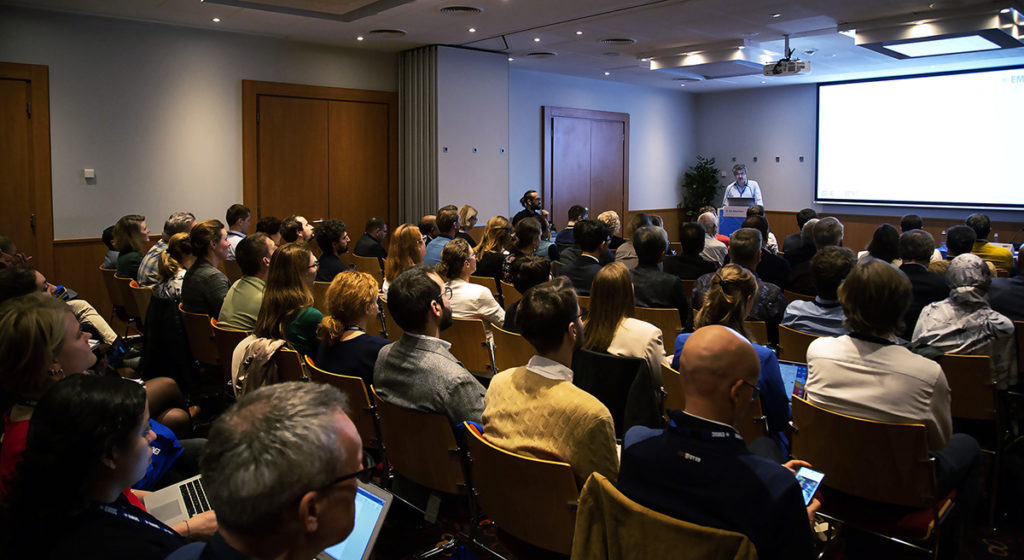
The ESUI meeting will merge with this year’s EMUC23 programme.
In addition, one of the most popular features of the scientific programme, the Multidisciplinary Case Discussions, will be more data-driven, infused with robust statistics, and delivered in an improved structured format.
To enrich the EMUC23 experience, the exhibition will also be a must-visit element of the congress showcasing innovations in equipment, scientific publishing, and pharmaceuticals.
EMUC23 and nuclear medicine
Prof. Daniela Oprea-Lager (NL) stated that attending EMUC23 will not only be beneficial to her fellow nuclear medicine physicians, but to other healthcare professionals as well. “The congress will deliver novel developments from the preclinical to the clinical levels of interest. EMUC23 will be a platform where various perspectives are offered and topics on imaging are adequately integrated during the patient case discussions. Experts from diverse fields will brainstorm and deliberate to improve clinical practice and to avoid futile treatments in categories of patients who might not respond to therapy.”
Prof. Oprea-Lager shared that her favourite EMUC sessions are the Multidisciplinary Case Discussions and Game Changing sessions, where interdisciplinary collaboration will be at its pinnacle. She said, “Generally, there are various possibilities when treating certain patients. The key is selecting the most appropriate approach, capitalising the benefit, and minimising the adverse effects and costs.”
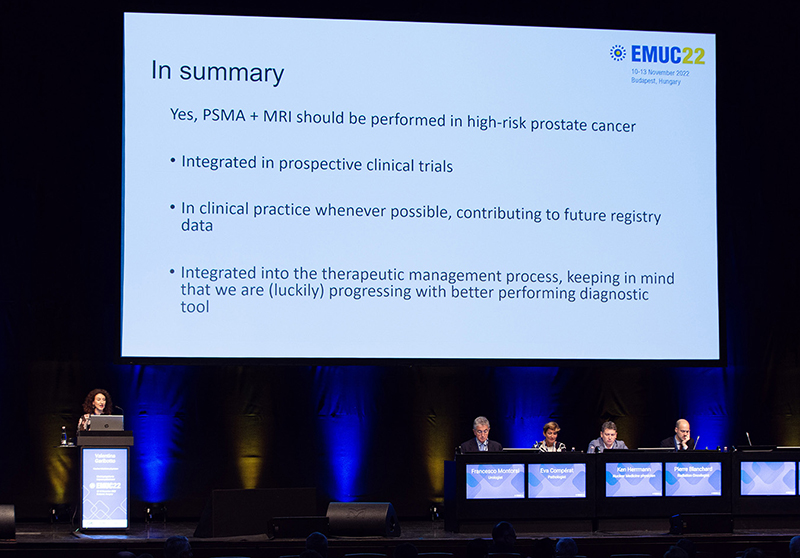
During EMUC22, nuclear medicine physician Prof. V. Garibotto (CH) deliberates why PSMA + MRI should guide treatment algorithm in high-risk prostate cancer.
Role in the MDT
“With the implementation of next-generation imaging and the theragnostic concept in clinical practice, the tasks of the imaging doctor became complex. We see what we treat and we treat what we see, but the aims are to position the patient centrally and to act from an individualised perspective,” she said. According to Prof. Oprea-Lager, this is how to carry out these aims:
-
-
-
- Speak the same language with clinical partners
“Imaging doctors, nuclear medicine physicians, and radiologists, need to have the knowledge and high level of expertise to function as equal discussion partners.” - Identify the gaps in daily practice
“Push the limitations and innovate towards answering clinical needs by using imaging tools.” - Be aware of the consequences of “seeing more and treating more”
“Nowadays when we see more, we may upstage/downstage disease and change the initially proposed treatment plan for a still unknown survival benefit. However, the nuclear medicine physician has to possess a good understanding of all factors related to disease history, current medical status, metastatic patterns of urological cancers, pitfalls, and final image interpretation. Once we have these, we can adequately stage/re-stage patients and plan the optimal treatment in dialogue with the clinicians in the MDT and with the patient.” - Adequately select and identify the ideal candidates (i.e. patient categories that may benefit from the proposed treatment)
“Patient selection and response evaluation criteria based on harmonised, repeatable protocols, and adequately performed scans are some of the most challenging tasks of the new-generation imaging doctors.”
- Speak the same language with clinical partners
-
-
Solving dilemmas together
According to Prof. Oprea-Lager, MDT has been implemented in the Netherlands for more than 10 years. However, the presence of radiologists and nuclear medicine physicians in the MDT is a novel element. She explained, “It all began with the need to have all key specialties present in the multidisciplinary process of diagnosis and treatment of patients with urological cancers. Nowadays, specialist diversity is a matter of shared decisions and best-practices approach within the large uro-oncology domain. We are not competing with other disciplines; we try to solve dilemmas together, and successfully translate anatomic and metabolic knowledge into the clinical pathways.”
EMUC23 and medical oncology
“We, medical oncologists, generally focus on advanced disease. Most scientific meetings have sessions that only cover this topic and topics related to it. In contrast, EMUC provides updates and knowledge exchange on various stages of GU cancers. It is during the early stages that plenty of evidence is generated. This can change or will change clinical practice. With this in mind, it is in the best interest of our patients to keep ourselves updated and EMUC can help with that,” said Dr. Elena Castro (ES).
Advantages of MDT
According to Dr. Castro, when the management of GU tumours becomes increasingly complex due to multiple treatment options, a well-coordinated MDT is paramount in pinpointing the most appropriate disease management. She explained, “This is especially true in patient cases with particularities that have more than one potential option and/or when the Guidelines do not currently offer clear recommendations. I personally find MDT discussions very helpful in coming up with the best care possible as the decision is not based on one person’s point of view. Additionally, MDTs are essential in identifying candidates suited for clinical trials as they could benefit from treatments not yet widely available.”
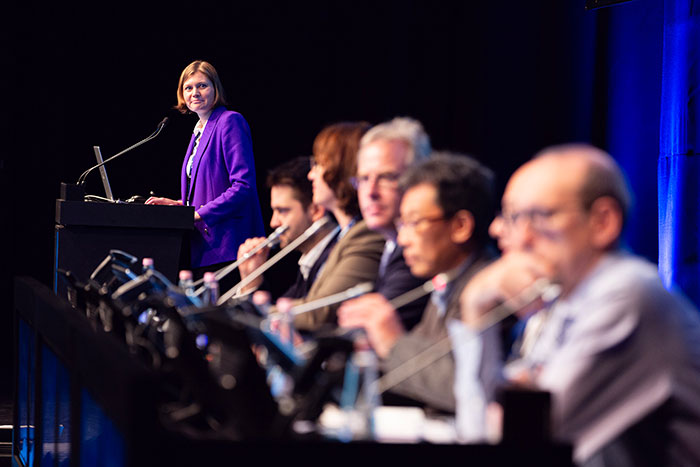
Urologist Dr. T. Kuusk (GB) presents a case on adjuvant treatments and recurrent disease during the Multidisciplinary Case Discussion session on kidney cancer at last year’s EMUC.
Dr. Castro shared that in her practice, most GU patients with localised disease who benefit from localised treatment or even surveillance, are usually managed by urologists or radiation oncologists. However, there are some cases that may require neoadjuvant or adjuvant systemic treatment. Thus, coordination between surgeons and medical oncologists is key.
Patients with (recurrent) metastatic disease are usually referred to the medical oncologist. Concerning prostate cancer, some patients with metastatic disease are managed by urologists or radiation oncologists. These patients are then referred to the medical oncologists after progression to the initial therapy or if the most appropriate treatment requires chemotherapy or other systemic treatments.
Spain’s take on MDT
“If not in all, in most tertiary hospitals in Spain, MDTs are the common way to manage cancer patients for GU tumours and most tumours. The composition of the MDTs may vary depending on the specialists that are relevant for a particular tumour type, but MDTs typically include surgeons, medical oncologists, radiation oncologists, pathologists, and radiologists. For instance, for prostate cancer, it is important that the nuclear medicine specialists are also involved,” stated Dr. Castro.
MDT becoming compulsory?
According to EAU Secretary General and EMUC Steering Committee member, Prof. Arnulf Stenzl (AT), an MDT’s involvement in treating onco-urology patients may become imperative in health insurance matters. He stated, “We see insurance companies and authorities in several countries require that onco-urology patients must be seen by a multidisciplinary tumour board to receive reimbursements for a systemic (or new interventional) treatment or diagnosis such as PSMA-related diagnosis or treatment. It would be beneficial if medical specialists become more informed in many aspects of GU cancer treatment beyond the scope of their core specialism.”
| Join us at EMUC23 |
| EMUC23 is an all-encompassing congress designed to enrich your clinical practice and patient care. Explore the congress’ scientific programme to know what’s in store for you. Secure your place at EMUC23 and register now to benefit from the early-fee rates. Don’t miss out! |
The post Synergy of specialties at EMUC23: Why MDTs are paramount to optimal patient care appeared first on EMUC25.
]]>